



Vicat Softening Point vs HDT: Thermal Testing of Plastics Explained
How hot can a plastic part get before it stops behaving like a solid? Two laboratory answers exist: the Vicat Softening Point (VSP, ASTM D 1525 / ISO 306) and the Heat Deflection Temperature (HDT — also called heat distortion temperature, ASTM D 648 / ISO 75). They measure different things and appear on datasheets for different reasons.
Both are run on a combined VSP / HDT Apparatus — an oil bath with calibrated loading stations, dial or digital indicators, and a controlled heating rate.
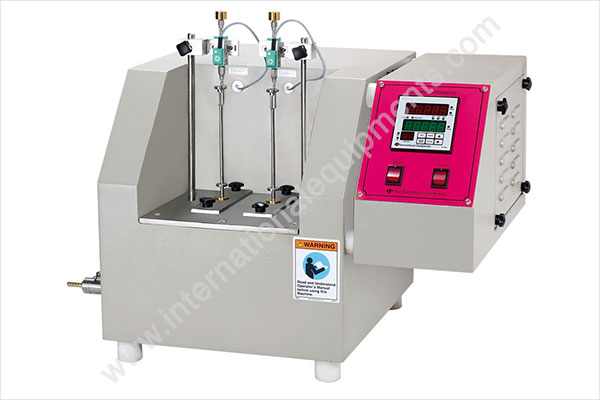
What Each Test Measures
- Vicat (VSP) — temperature at which a flat-ended needle of 1 mm² penetrates 1 mm into the specimen under 10 N or 50 N load. It reflects surface softening — relevant to hot-fill containers, fittings and electrical parts.
- HDT — temperature at which a bar deflects a set amount under a three-point bending stress of 0.455 MPa or 1.82 MPa. It reflects load-bearing stiffness at temperature — the number designers use for structural parts.
Rule of thumb: Vicat runs higher than HDT for the same material, because localized needle penetration requires more softening than bulk flexural deflection. Quoting one when a buyer asked for the other is a common and costly specification error.
Running the Test Correctly
Specimens are immersed in a silicone-oil bath heated at exactly 120 °C/hour (or 50 °C/hour where specified). Heating-rate accuracy is the heart of the apparatus — a fast bath reads high, a slow one reads low. Multi-station units test 2–6 specimens simultaneously, and automatic units record the trigger temperature the instant deflection or penetration reaches the limit.
International Equipments manufactures VSP/HDT apparatus per ASTM D 1525, ASTM D 648, ISO 306 and ISO 75 with precise heating-rate control, multiple stations and digital temperature capture — used by pipe, fitting and compounding laboratories across 60+ countries.
Related Thermal Tests
Thermal characterisation rarely stops at VSP/HDT. PE pressure-pipe grades additionally require Oxidation Induction Time (OIT) testing for stabiliser content, while ovens and furnaces cover heat reversion and ageing and ash content determinations.
Frequently Asked Questions
Which is higher for the same plastic - Vicat or HDT?
What loads are used in Vicat testing?
Why does the heating rate matter so much?
Is HDT the maximum service temperature of a plastic?
Need help selecting the right testing equipment?
International Equipments has manufactured and exported testing machines to laboratories in 60+ countries since 1971. Share your application and standards — our engineers will recommend the right configuration.
Request a QuoteBrowse All Machines