



Universal Testing Machine for Plastics: Tensile, Compression & Flexural Testing Explained
A Universal Testing Machine (UTM) is the workhorse of every polymer laboratory. One frame, fitted with interchangeable grips and fixtures, measures tensile strength and elongation (ASTM D 638 / ISO 527), compression (ASTM D 695) and flexural properties (ASTM D 790) — the mechanical numbers that appear on every plastic datasheet.
This guide explains how a computerized twin-screw Universal Testing Machine works, which tests it performs, and the specifications that actually matter when selecting one.
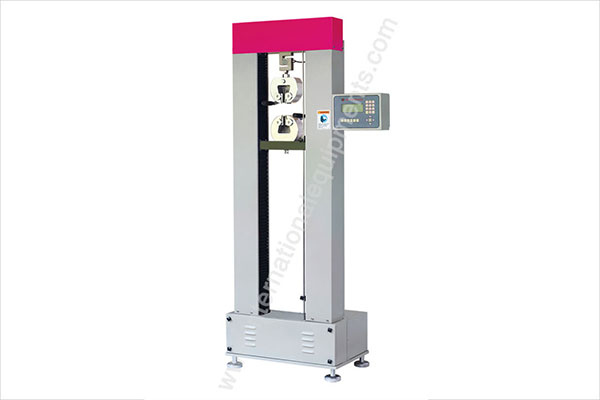
How a Twin-Screw UTM Works
Two precision ball screws drive a rigid crosshead at a controlled speed while a strain-gauge load cell measures force and an encoder (or extensometer) measures displacement. Software plots the stress–strain curve in real time and automatically reports yield strength, break strength, modulus and percentage elongation.
Twin-screw architecture keeps the crosshead perfectly parallel under load — critical for reproducible results on stiff engineering plastics, and the reason single-column machines are limited to low-capacity film work.
Tests One UTM Can Perform
- Tensile & elongation — ASTM D 638 dumbbells, ISO 527; films per ASTM D 882.
- Compression — ASTM D 695 on blocks and cylinders.
- Flexural (3-point bend) — ASTM D 790 / ISO 178 for stiffness of moulded parts.
- Peel, seal and bond strength — with film grips, replacing a dedicated tester for low-volume work.
- Adhesives, ceramic tiles & mosaics — shear bond, adhesion and pull-out tests with special fixtures, as on our UTM for Adhesives & Tiles.
Specifications That Matter
Capacity should be roughly double your expected maximum load for accuracy and load-cell life — 5 kN covers most films and small specimens, 10–50 kN covers rigid plastics and composites. Verify load accuracy of ±1 % across the working range, crosshead speed range wide enough for both rigid (5 mm/min) and elastomeric (500 mm/min) testing, and software that exports raw data for audits.
International Equipments builds computerized twin-screw UTMs with interchangeable grips for plastics, films, pipes, adhesives and tiles, validated to ASTM and ISO methods and supported with on-site installation and training.
Frequently Asked Questions
What is the difference between a UTM and a tensile testing machine?
What UTM capacity do I need for plastics?
Which standards apply to plastic tensile testing?
Does a UTM need an extensometer?
Need help selecting the right testing equipment?
International Equipments has manufactured and exported testing machines to laboratories in 60+ countries since 1971. Share your application and standards — our engineers will recommend the right configuration.
Request a QuoteBrowse All Machines