



Melt Flow Index Testing: The Complete Guide to MFI, ASTM D 1238 & ISO 1133
Melt Flow Index (MFI), also reported as Melt Flow Rate (MFR), is the single most widely used quality-control test in the plastics industry. It measures how many grams of molten polymer flow through a standard die in ten minutes under a specified load and temperature — a fast, low-cost indicator of molecular weight and processability.
India pioneered indigenous MFI testing in the 1970s, and International Equipments was the company that built the country's first Melt Flow Index Tester. This guide explains how the test works, what the numbers mean, and what to look for when buying an instrument.
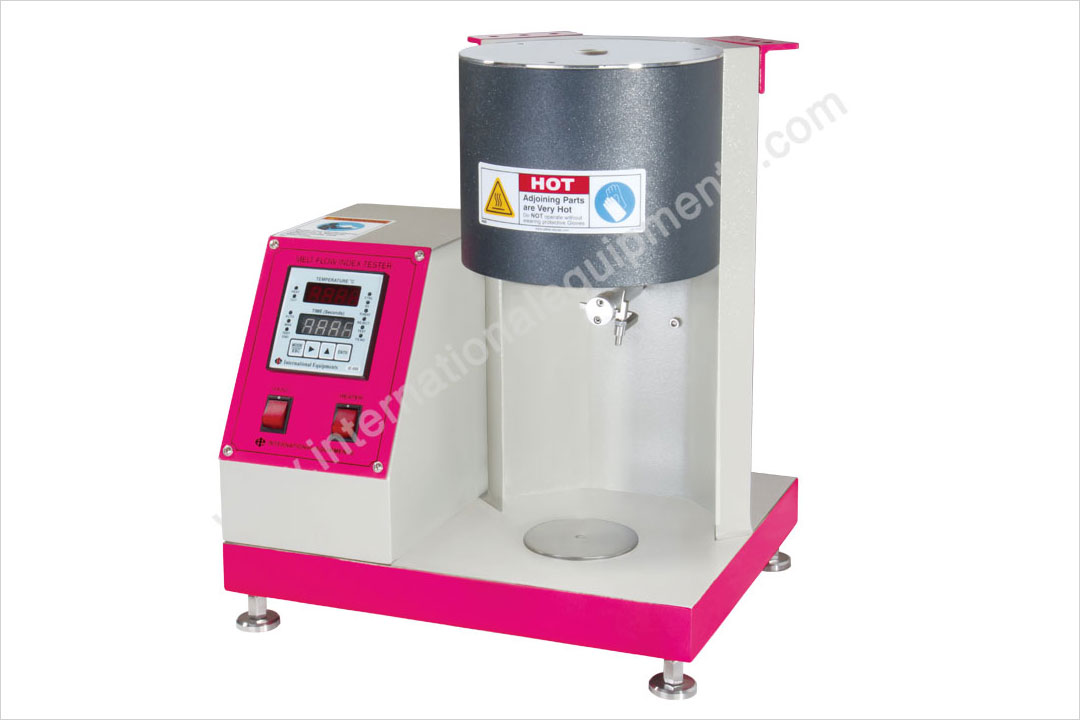
How the Melt Flow Index Test Works
The instrument consists of a heated barrel, a precision-bored die (2.095 mm), a piston, and calibrated dead weights. Granules are charged into the barrel, allowed to melt at the test temperature (for example 190 °C for polyethylene or 230 °C for polypropylene), and the piston is loaded with a standard mass such as 2.16 kg or 5 kg.
In Test Method A per ASTM D 1238, extrudate cut-offs are collected at fixed time intervals, weighed, and converted to grams per 10 minutes. Modern testers automate the cut-off with a motorised blade, which removes operator variation — the largest source of error in manual testing.
Typical MFI Values and What They Tell You
- Injection moulding grades generally need higher MFI (easier flow into thin cavities).
- Blow moulding and pipe grades use low MFI resins for melt strength and long-term durability.
- Film extrusion grades sit in a narrow band — drift in MFI shows up immediately as gauge variation.
- Incoming raw material checks: a lot whose MFI deviates from the datasheet is the fastest early warning of degraded, contaminated or mislabelled resin.
Because MFI correlates inversely with average molecular weight, a rising MFI on regrind or recycled resin quantifies polymer degradation — one reason MFI testers are mandatory equipment for recycled plastics processors.
Choosing a Melt Flow Index Tester
Look for microprocessor temperature control with ±0.1 °C stability, a hardened and honed barrel, dies manufactured to standard tolerance, auto cut-off, and a weight set covering the loads your polymers require. For laboratories supplying CE-marked or export product, insist on calibration documentation traceable to national standards.
International Equipments manufactures MFI testers compliant with ASTM D 1238 and ISO 1133 (Test Method A) with automatic extrudate cutting, supplied with calibration certificates and installation support in 60+ countries.
Frequently Asked Questions
What is the difference between MFI and MFR?
Which temperature and load should I use for my polymer?
How often should an MFI tester be calibrated?
Can MFI testing be used for recycled plastics?
Need help selecting the right testing equipment?
International Equipments has manufactured and exported testing machines to laboratories in 60+ countries since 1971. Share your application and standards — our engineers will recommend the right configuration.
Request a QuoteBrowse All Machines